
WRITTEN BY: Catechist Branislav Ilić, editor of the portal „Kinonia“
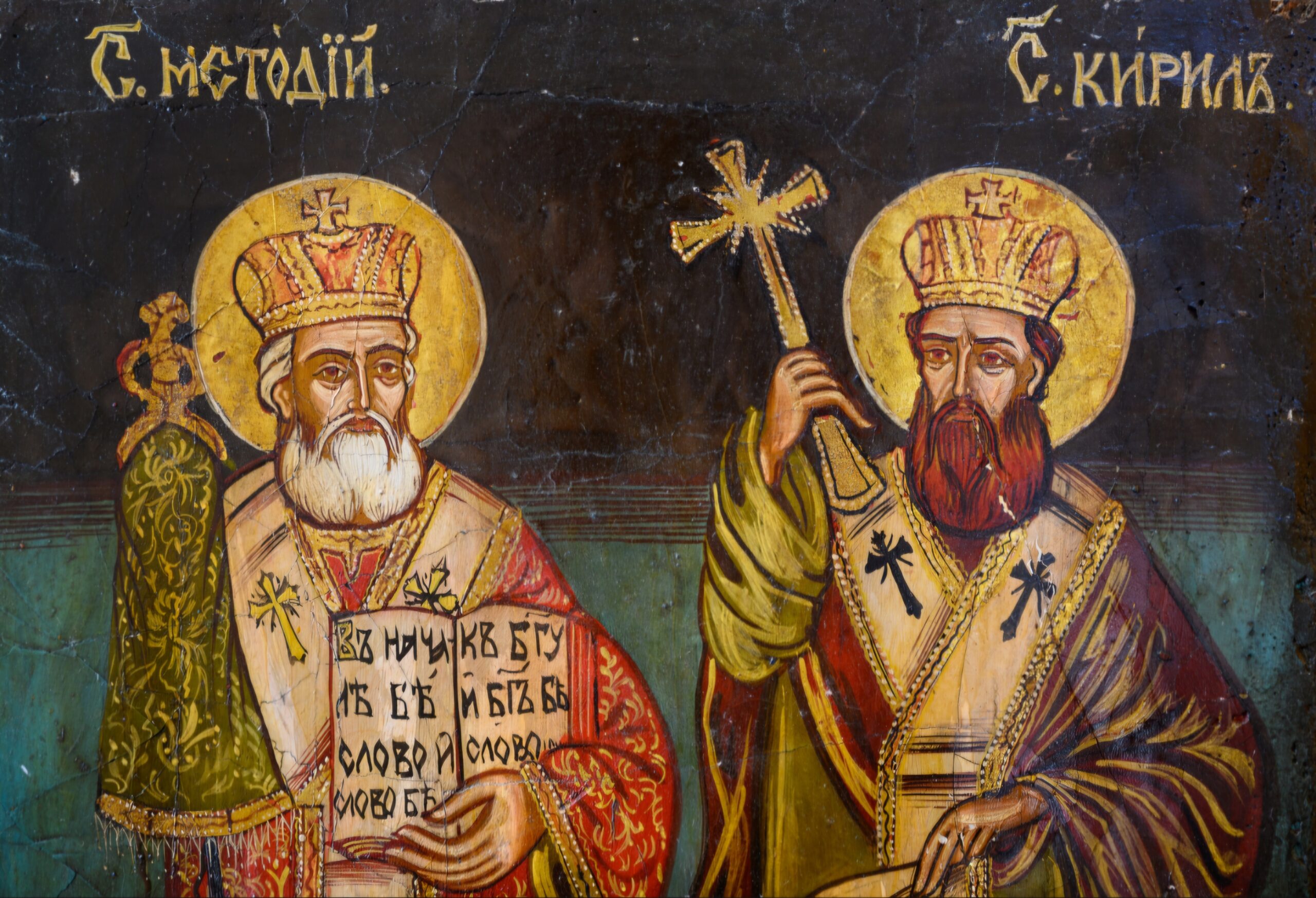
“With what praiseworthy wreaths should we crown the God-Wise Teachers, who enlightened the Slavic peoples with the light of the Gospel, who were in the darkness of ignorance and the shadow of death.” The church poet expresses the delight of the entire Church that creates the radiant image of these wonderful men of God and enlighteners of the Slavs, and he does not know with what songs he could more worthily and deservingly praise the memory, feat and their work as equal to the apostles. The holy brothers Cyril and Methodius, as enlighteners of the Slavic peoples, are as pleasing to God and great before people as the apostles of Christ, which is why the holy Church prayerfully extols them as equal to the apostles.
Saint Cyril (Constantine) was born in July 826, and reposed on February 14, 869 in Rome. Saint Methodius was born between 816 and 820, and died on April 6, 885. Both were born as Orthodox Greeks in Thessaloniki. They were born to pious parents, Leo and Maria. Father Leo was a Byzantine military commander. According to historical testimonies, Methodius was appointed governor of an archonship in eastern Macedonia, while his brother Cyril was raised at the imperial court, and after completing his philosophical and theological studies, he was appointed librarian of the Church of St. Sophia in Constantinople and a teacher of philosophy at the Constantinople Higher School. In 851, Cyril became a member of the Byzantine mission to the Arab caliph in Samarra. The holy brothers played their main role when they were sent by the Byzantine emperor and the Patriarch of Constantinople to preach among the Slavs. They first went to Central Europe, to the areas of present-day Moravia and Bohemia, where their preaching was very successful, and the people began to accept the Orthodox faith en masse.
Their preparation for this obedience was reflected in the compilation of the Slavic alphabet and the translation of liturgical books, so that the people could worship in their own language. Thus, Cyril first compiled the first Slavic alphabet, the Glagolitic alphabet. Saint Cyril wrote the Slavic alphabet, which we call Cyrillic today, and for the Western Slavs he compiled the Glagolitic alphabet. Thus, both Cyrillic and Glagolitic alphabets originate from Saint Cyril. These holy brothers also translated liturgical books into the spoken language of the time, as well as the Holy Scriptures. We can freely say that they laid the foundations of Slavic literacy and culture, including all Slavic peoples: Russians, Bulgarians, Serbs, Croats, Slovenes, Slovaks, Czechs and Poles. All of them, together as Slavs, received the Orthodox faith from Saints Cyril and Methodius. In their God-pleasing mission, they also had many temptations that they overcame with faith, and the greatest temptation was the persecution they endured from the West. One of the biggest reasons for their persecution and opposition to their God-pleasing work was the well-known trilingual theory according to which there are only three languages in which sacred worship can be performed: Hebrew, Greek and Latin. When Saints Cyril and Methodius were exiled from Bohemia and Moravia, they went to Rome for a blessing. Saint Cyril reposed in Rome, and Saint Methodius was appointed Bishop of Pannonia.
Their God-pleasing work and mission did not end with their repose, for their faithful disciples and successors zealously continue their work in the field of translating and spreading the word of God, and they also complete that God-pleasing mission. Their holy disciples are called the Five: Clement, Nahum, Angelarije, Sava and Gorazd. The immense importance of the holy brothers Cyril and Methodius, as well as their disciples, is reflected in the translation of liturgical books, and for this reason hymnography glorifies and celebrates them with special attention, calling them diligent workers in the field of translation. Thus, in one of the sittings at Matins, all their works are listed, and it is said that they are deserving that we today understand the words of the Gospel and the divine service, and above all the words of the Holy Eucharist. The hymnography of their memory calls them both equal-to-the-apostolic hierarchs and enlighteners who sowed the seeds of divine knowledge and piety among the Slavic people.
The church poet reminds us in several places that Saints Cyril and Methodius enlightened the Slavic peoples with the light of the Gospel, and that thanks to them the unquenchable light of Christ’s teaching shone throughand the entire Slavic world. Saints Cyril and Methodius sowed the seed of the Gospel on fertile soil, which is why the ocean of Slavism has been roaring for centuries and filling it with the harmony of faith, piety and cultural uplifts of the entire history of humanity. History has recorded in bright letters the merits of the holy brothers Cyril and Methodius. Driven by missionary zeal, as faithful servants of the Divine Enlightener Jesus Christ, they gave themselves to the struggle and perseverance, in order to to devise the Slavic alphabet, with the help of which the Gospel truth would be revealed to the Slavic peoples. They translated sacred writings and church books from the Greek original into the Slavic language, so that the gospel enlightenment could penetrate deep into the hearts of the people and revive them for a new life. For centuries, Christians have expressed the experience of their faith and inner encounter with their Creator in words through prayer, thanksgiving and glorification of God, through worship and singing, and by writing spiritual and theological books. The word is an expression of the human soul, through it each person reveals to others how educated, noble, enlightened, and spiritualized he is (or is not). In this spirit, the Church recognized the mission of spreading the Word of God and the truth about His mission among various pagan, unenlightened, and illiterate peoples as a work and feat equal to the apostolic mission. To translate into someone’s own language the word with which the Lord addressed the world and thereby give them a chance to understand it is a testimony of great love, creativity, and sacrifice. This is precisely where the significance of the holy God-bearing and Equal-to-the-Apostles Cyril and Methodius, teachers and enlighteners of the Slavs, can be seen.
With Saints Cyril and Methodius, the Slavs perhaps gained more than other peoples. One of our contemporary theologians has nicely noted that the challenge of the Cyrillic-Methodist mission was twofold – along with Christianization, the foundations of a culture that was being Christianized also had to be laid. They succeeded in this blessed undertaking. Through their efforts, the new wine of Christianity was poured into new wineskins, which were skillfully crafted precisely for that purpose and which, for that very reason, promise not to leak and to last forever. Thus, the Slavs received from Cyril and Methodius not only the content but also the form of Christianity.
We began our reflection on the Equal-to-the-Apostles Saints Cyril and Methodius by relying on hymnography, and we conclude in this spirit. In the glory of the Lord, we call upon Him, and with the following words we glorify the Lord and His saints, who have been honuored to be called equal to the apostles: “Come, lovers of feasts, let us praise those who are equal to the apostles, the adornment of the hierarchs, and the enlighteners and fervent advocates of the Slavic peoples, and let us say to them in songs of praise: Rejoice, Cyril, gilded trumpet of theology, for you have explained the mystery of the Holy Trinity by the example of the sun, and thus you have closed the blasphemous mouth of the Agaryans; Rejoice with him, you too, Methodius, for you have striven with him in unison, and have helped him with prayers and signs; and now, all-blessed fathers, do not cease to pray for us to Christ God, for we glorify you with faith and love.”