
WRITTEN BY: Catechist Branislav Ilić, editor of the portal „Kinonia“
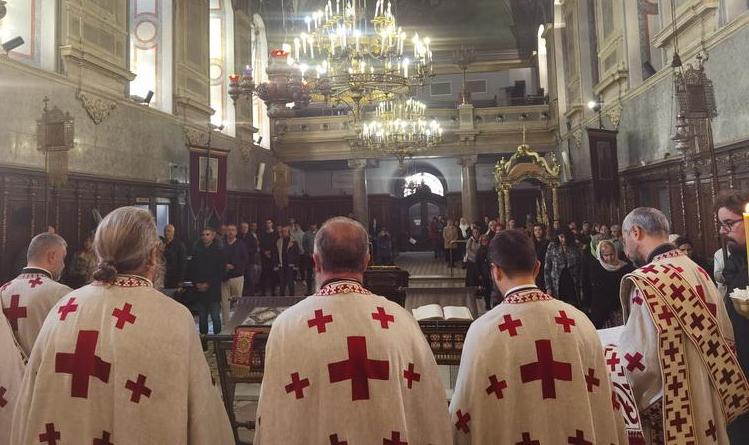
With the blessing of His Eminence, Metropolitan of Bačka, Dr. Irinej, and a loving welcome of Protopresbyter Petar Bikar, parish priest of the Church of the Dormition of the Most Holy Theotokos in Pivnice, we participated in the ancient Liturgy of the Holy Apostle and Evangelist Mark.
The liturgy which is known by the name of the holy apostle and evangelist Mark was not written by him, but there is a good reason it kept its name orally, and within the sacred tradition, since it was the most important liturgy in the Greek language in Alexandria and Egypt, where Saint Mark founded the first Church. The commemoration of the Council of the Holy, Glorious and All-Praiseable Apostles, which we celebrate in worship, reminds us with its hymnography of the great role that the apostles played.
By celebrating the ancient Liturgy on the day of their conciliar celebration, we point out that liturgical gatherings were the foundation and crown of the apostolic ministry. The holy apostles, disciples of Christ, having received from their Master the commandment to celebrate the Holy Eucharist in memory of Him, after His Ascension began to celebrate the breaking of bread—the Eucharist, to which the following words testify: The Christians continued steadfastly in the apostles’ teaching and fellowship, in the breaking of bread and in prayers (Acts 2:42). The liturgical rite was formed gradually. At first, the apostles celebrated the Eucharist in the same order that they had adopted from their Master.
In apostolic times, the Eucharist was united with the so-called agape (love feasts). Christians ate food and spent time in prayers and brotherly communion. After dinner, the breaking of bread and the communion of believers took place. Later, the Liturgy was separated from the meal and began to be performed as an independent church rite. The Eucharist began to be performed inside holy temples. In the 1st and 2nd centuries, by all accounts, and the order of the Liturgy was not written down but was transmitted orally. Gradually, different liturgical types emerged in different regions. In Jerusalem, the Liturgy of the Apostle James was served, in Alexandria and Egypt, the Liturgy of the Apostle Mark, in Antioch, the Liturgy of St. Basil the Great, as well as the Liturgy of St. John Chrysostom.
The Holy Anaphoras were created by the inspiration of the Holy Spirit and with great trembling carried out by those who pleased God and were honoured to serve this great mystery. That this is truly so, we read in the account of our Holy and God-bearing Father Amphilochius of Iconium, who testified with divine wisdom about the origin of the Anaphora attributed to Saint Basil the Great, Archbishop of Caesarea in Cappadocia: “Saint Basil the Great prayed to God to give him the strength of spirit and reason to perfect the Liturgy with his own words. After six days of fervent prayer, the Saviour appeared to him in a miraculous way and answered his prayers. Soon after, Basil, being imbued with ecstasy and Divine trembling, began to exclaim: Let my mouth be filled with praise; and hear, O Lord Jesus Christ our God, from Your holy dwelling place, the rest of the prayers of the Liturgy.”
At the Last Supper, the God-man offers himself to all people not in the form of flesh and blood, but in the form of Bread and Wine. Bread is a symbol of all humanity; in this spirit the Liturgy also overcomes loneliness among people, uniting them into One Church. The Liturgy overcomes division in our relationship with God, making us His participants, which is reflected in the beauty of liturgical communion. In the Mystery of the Divine Eucharist, the boundless love, mercy, and abiding presence of God in the world are perfectly manifested. At the same time, the Mystery of the Lord’s Sacrifice shows us the spiritual path that we should walk in our lives, in order to give good testimony and become light to the world and salt of the earth, following the example of the saints of our Church, who, walking the narrow path, became bearers of the grace of the Holy Spirit in all ages.
Gathered today at the ancient Liturgy of the Holy Apostle and Evangelist Mark, while the spirit of the ancient Church wafts through our being, and images that testify to the peculiarities of the Church of God in ancient Alexandria and Egypt alternate before our spiritual eyes, we pray that the Lord, who loves humanity, may preserve in our being this gracious fire that has been kindled for as long as possible. As the deer longs for springs of water, so my soul longs for You, O God. Amen.
NOTE: The text was written after the service of the ancient Liturgy of the Holy Apostle Mark in the Church of the Dormition of the Most Holy Theotokos in Pivnice, on July 13, 2026.