
WRITTEN BY: Catechist Branislav Ilić, editor of the portal „Kinonia“
The Salvation Mystery of the Ascension
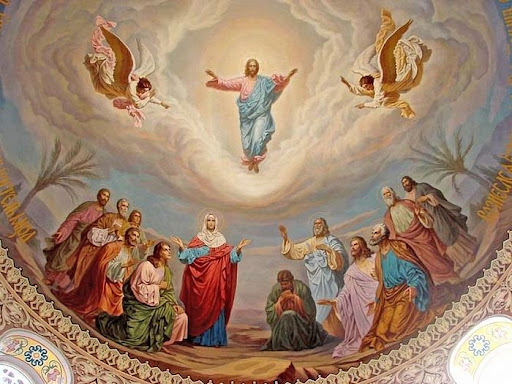
The Feast of the Ascension of the Lord always falls on the fortieth day after the Resurrection of Christ. During those forty days, the Lord appeared to his disciples, assuring them of his Resurrection and revealing to them the mysteries of the Kingdom of God. Finally, on the fortieth day, he appeared to them for the last time and revealed that he would ascend to heaven, promising to send them the Holy Spirit the Comforter.
He led them to the Mount of Olives, “lifted up his hands and blessed them. And when he had blessed them, he departed from them and was carried up into heaven. And they worshiped him” (Luke 24:50-52) and they looked up into heaven until a cloud hid him. Then two angels in white robes appeared and said, “Men of Galilee, why do you stand looking up into the sky? This Jesus, who was taken up from you into heaven, will come back in the same form as you saw him” (Acts 1:11). For a long time the apostles stood and looked in the direction in which the Lord had ascended. Of course, they could have been filled with sadness that the Lord had left them forever, but they could not be sad, because the Lord had said to them, “And behold, I am with you always, even to the end of the age” (Matt. 28:20). This was to encourage and comfort the apostles. They knew that the Lord would not abandon them, and that He would soon send them the promise of the Holy Spirit, that the Lord would always be with them, watching over them, governing them, guiding them, and helping them in everything by His divine and kind Providence. Therefore, when they accompanied the Lord to heaven, as the Gospel says, “they worshiped him and returned to Jerusalem with great joy. And they were continually in the temple, praising and blessing God” (Luke 24:52-53).
After this, the apostles returned to Jerusalem, not with sorrow for their Divine Teacher, but with great joy. They were filled with joy because the Lord’s Ascension had finally convinced them that Jesus was the Son of God, the Saviour of the world, the true Lord and God. The apostles were comforted by the Lord’s promise that He would send the Holy Spirit the Comforter.
The Ascension of the Lord teaches us that the Lord’s Passover continues. At the festive matins of the feast of the Ascension of the Lord, we hear the hymn “Having seen the resurrection of Christ” after the Gospel. Although there already was leave-taking of the “feast of feasts”, we still recite the prayer “Having seen the Resurrection of Christ.” This is no coincidence. The Resurrection of Christ and His Ascension are interwoven and form a single whole. For forty days, the resurrected Christ appeared to His disciples and apostles, confirming and strengthening their faith in His Resurrection. And after this, He ascended to heaven. With His Ascension, the Lord raises all of humanity to heaven, opens the way to God for all of us, clears the way for us and prepares the beaten path along which we must walk, for He is the way, the truth, and the life (John 14:6).
Ascension as a holiday
In our people, it is not by chance that we call the feast of the Ascension Salvation Day. The name Spasovdan indicates that the feast of the Ascension of the Lord fulfilled and completed the work of salvation, everything that the Lord had in his eternal plan was fulfilled by this great feast of the Lord. The feast of the Ascension of the Lord was not always celebrated on the fortieth day after Easter, but Pentecost, as a blessed period, was the time of perfecting the liturgical commemorations of the great feasts. Some fathers mention that the Ascension was at one time celebrated together with the feast of the Descent of the Holy Spirit upon the Apostles, but this dual celebration did not last long, because already from the time of Saint John Chrysostom we have the first homilies on the feast of the Ascension as a separate feast. This separate celebration of the Ascension on the fortieth day after Easter also led to it receiving its own pre-feast and post-feast. The place from which our Lord ascended to heaven has been especially revered since the very beginning – on that spot a magnificent temple was built by the Holy Empress Helena which was, unfortunately, at one point completely destroyed by the Saracens
The hymnography of this wonderful feast has a dual character, primarily joyful, but in some sticheras moments of sadness of the apostles who are joyless due to the ascension of the Saviour to heaven are noticeable. In today’s Ascension service, one stichera has been preserved that testifies to the dual celebration of the Ascension and Pentecost, and it is one of the sticheras at Vespers. Like other great feasts of the Lord, the Ascension has its own special antiphons at the Liturgy, an entrance stichera, as well as a communion stichera. We will crown this festive reflection with the text of the festive kontakion: “Having fulfilled God’s providence for us and uniting the earthly with the heavenly, you ascended in glory, O Christ our God, not separating yourself in any way, but remaining present, You say to those who love You: I am with you and no one can be against you.”