
WRITTEN BY: Catechist Branislav Ilić, editor of the portal „Kinonia“
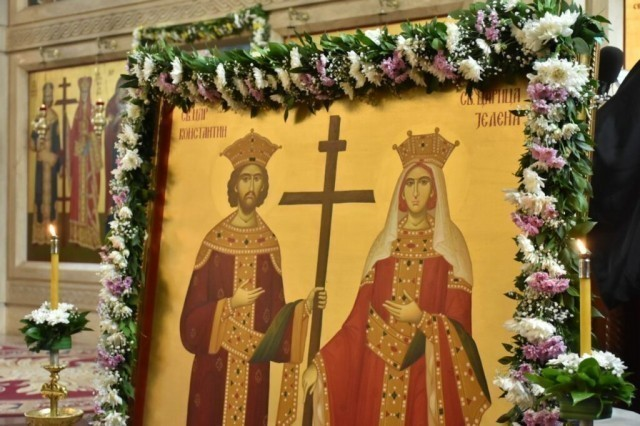
The Holy Equal-to-the-Apostles Emperor Constantine and his mother Helena lived in the Roman Empire at the turn of the third and fourth centuries. When Constantine ruled Roman Gaul and Britain, he ordered the persecution of Christians there to cease. At that time, the Roman Empire was so large that other provinces also had their own emperors. These emperors, being fiery pagans, were hostile to Constantine, but were ultimately defeated. Before one of the decisive battles, Emperor Constantine fervently prayed to God for a sign that would inspire his army. Suddenly, a cross appeared in the sky with the inscription: “By this conquer.” Constantine immediately ordered crosses to be painted on the shields of his soldiers and, despite the numerical superiority of the enemy, he defeated the enemy and soon became the sole emperor of the entire united Roman Empire. Seeing the destructive influence of paganism, Emperor Constantine moved the capital from Rome to his new city, called Constantinople.
During his reign, remembering his mother’s teachings, Saint Constantine provided every assistance to Christians who had suffered persecution for so many years. He built churches and made one of his main goals the discovery of the Life-giving Cross of the Lord. With God’s help, the emperor’s noble aspirations were fulfilled. Thanks to the efforts of the holy Equal-to-the-Apostles Emperor Constantine and his mother Helena, many former pagans who inhabited the vast expanses of the Roman Empire converted to Orthodoxy. As the pagans converted to Christianity, misunderstandings of Orthodox teachings and even heresies sometimes arose. To combat these false teachings, the emperor convened the First Ecumenical Council in 325, condemning the heresy of Arius. At the First and Second Ecumenical Councils, the Creed was formulated. The Holy Emperor Constantine, Equal to the Apostles, proposed that the phrase “Consubstantial with the Father” be added to the prayer in order to reinforce the truth about the divinity of Jesus Christ, who took on human nature for the redemption of all mankind. Our local Church rightly boasts of the Holy Emperor Constantine. It does not boast only of his birth here, in ancient Naisos, today’s Niš, but of everything he saw and achieved. The Niš of that time was not some remote village, nor was it powerful Rome, nor ancient Athens, nor wealthy Corinth, nor cosmopolitan Alexandria. But nevertheless, the providence of God, which always works in ineffable ways and glorifies the small in the great, granted that none of these cities would produce a man and emperor who understood the greatness of the person and teaching of Christ as much as the great Emperor Constantine did. Not exalting himself by his origin, he became famous for his great deeds – as an emperor and a statesman, but first and foremost as a lover of freedom, a liberator, and a worshipper of the Cross and Christ. That is why he was neither carried away by the patriotic pride of the Romans, nor by the pride of ancient philosophy, nor by the arrogance of the Corinthians, nor by the indifference of the Alexandrians. This pious emperor was enlightened by the light of Christ’s Resurrection and His victory over death, so that through the Cross of Christ he became greater, more glorious, more spiritually rich, and a greater cosmopolitan than all his predecessors. Seeing the Silent Light of the Holy Glory of the immortal Heavenly Father, the Holy Emperor Constantine saw further and clearer than any of his predecessors on the Roman throne.
Saint Helena raised a son who changed the course of history. And Saint Constantine was grateful to his mother and listened to her wisdom. We often talk about raising children, but we forget that behind every worthy person there are parents who prayed, suffered, taught and loved. The memory of Saints Constantine and Helena reminds us of the importance of the family, of the love between parents and children, of mutual respect between generations.
Saint Helena became famous for finding the Life-giving Cross of the Lord. This great and holy mother was looking for the greatest relic of the Christian world. But each of us must also look for our own cross – not a wooden one, but a spiritual one. We must seek God’s will, we must seek the path to salvation, seek God’s presence in our lives. Saint Constantine showed that even a person who has power and wealth can understand that without God it is impossible to build a true life. We live in a world where people think that happiness can be bought, earned or achieved through success. But the story of Saint Constantine tells us something else. It tells us that a person becomes truly strong only when God is by his side. Rich life and spiritual experience tells us that it is easier to destroy than to build; it is easier to offend than to forgive; it is easier to lie than to believe; it is easier to reject than to love. The Holy Emperor Constantine and Helena chose the more difficult path. They did not destroy, but built. They did not divide, but united. They did not seek their own glory, but sought the glory of God. We are called to follow their example and thus please God.