
WRITTEN BY: Catechist Branislav Ilić, editor of the portal „Kinonia“
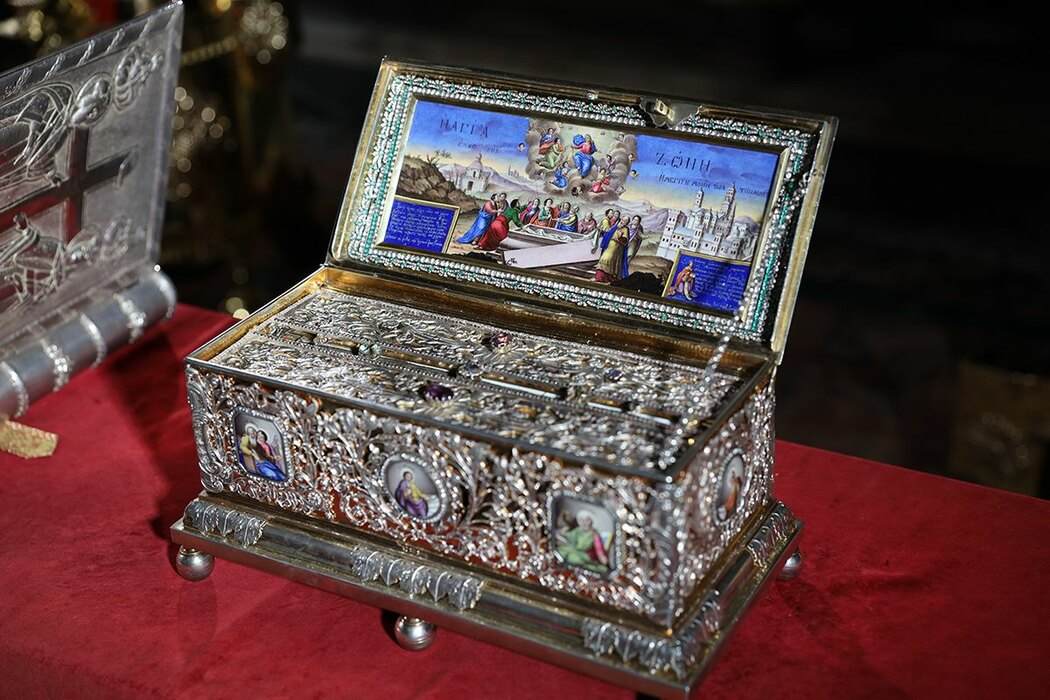
The Girdle of the Most Holy Theotokos is the only preserved relic from the earthly life of the Theotokos. It is one of the oldest and most revered Christian relics. The Miraculous Girdle, touching the Most Pure Womb that bore the Creator and soaked with drops of milk that nourished the One who is the Life of the World, is a testimony to the miraculous love of God for all of His creation, and especially for man as the crown of creation.
There are two versions of the discovery of the Miraculous Girdle of the Most Holy Theotokos. According to the first, the Theotokos wove the Girdle of camel hair with her own hands and after the Dormition gave it to the Apostle Thomas, who was late for her funeral and was very upset. In order to comfort him, the Theotokos took off her girdle and gave it to the apostle from heaven. The stone on which the Apostle Thomas stood at that moment is located in the monastery of St. Mary Magdalene in the Garden of Gethsemane. According to another tradition, the Belt and the Robe of the Most Holy Theotokos were given to two poor Jewish women who served her. They carefully guarded these sacred relics, which were passed down from generation to generation. It is known that in the first centuries the Belt was kept in Jerusalem, and then around 530 it found its refuge in Constantinople in the temple of Chalcopratia, where it was placed in a beautiful ark and sealed with the golden seal of Emperor Arcadius. This seal marked the exact date of the installation of the Belt in Constantinople – August 31 / September 13, which is to this day the day of the liturgical commemoration of the Belt of the Most Holy Theotokos.
Many years later (around 888), Zoe, the wife of Emperor Leo VI the Wise, fell seriously ill due to the possession of an unclean spirit. She had a dream in which she was told that she would be healed if the Holy Belt of the Most Holy Theotokos was placed on her. The emperor immediately ordered the seals on the ark containing the relic to be broken and, to his astonishment, he saw the Holy Belt shining and clean, as if it had been woven yesterday. Nearby lay a message stating the day the Belt was transferred to Constantinople and describing how the emperor himself placed it in the ark and sealed it with his own hand. Emperor Leo bowed with reverence to the relic and handed it over to the patriarch. He placed the Belt on the empress’s head and she was immediately healed of her illness. Everyone offered praise to Christ the Saviour and His Most Pure Mother. The grateful empress embroidered the Belt of the Virgin with gold thread, and the holy relic was returned to its ark.
The Bulgarian Emperor Asen (1187–1196), after defeating Emperor Isaac II the Angel (1190), captured the cross containing a part of the Holy Belt. The priest threw this cross into the river to prevent its desecration. The relic then found its refuge in Serbia, and the holy prince Lazar (†1389) donated the Miraculous Belt of the Virgin to the Vatopedi monastery on Mount Athos, where it is kept to this day.
For centuries, multitudes of believers have gathered around this shrine with reverence, asking the Virgin Mary to intercede for us before the throne of God with her prayers. The Holy Belt has performed and continues to perform numerous miracles. People in trouble and pain find solace in the miraculous power of this sacred relic through which God’s love is manifested. The Miraculous Belt, through the prayerful intercession of the Most Holy Mother of God, sanctifies the faithful who approach it with devout devotion, lifts them from earthly difficulties and frees them from illness and sorrow. There are countless testimonies stating that childless couples receive children before the Miraculous Belt of the Most Holy Mother of God. In one liturgical song, a church poet prays before the Miraculous Belt of the Mother of God with the following words: “O Belt, who surrounds the Source of life and gives eternal life to all who honour you. O Belt, who always grants those who resort to you the mortification of passions, courage and strength to acquire virtues. O Belt, who prevents us from falling and gives strength to the weaknesses of our nature, and defeats our visible and invisible enemies. O, Venerable Belt, who surrounds and protects your city and your people, and saves them from every barbarian invasion.”
“By the intercession of the Mother of God, Saviour, save us!” This prayer is sung at the Holy Liturgy. The Mother of God does not save, but without her we are not saved. Through her we come to know Christ the Saviour. At the heart of the Orthodox faith, the Mother of God occupies a special place. Her name is mentioned in the Holy Scriptures, and church tradition is enriched with numerous records of her miraculous interventions. She is not only the mother of Jesus Christ, but also an icon of the Church and the advocate of all believers.
In the person of the Most Holy Theotokos, the Church recognizes that creature who, in the entirety of God’s creation, both material and spiritual, has reached the fulfillment of the goal for which creation exists: the most complete possible union with God. The Virgin Mary’s consent to the incarnation of her Son, her „Yes,“ addressed to God, represents not only her consent and obedience to God, but also the unique fact of the mutual interpenetration of the life of the created and the life of the uncreated. The Theotokos did not simply lend her biological functions to God the Logos, for a mother never lends her body to her child, but builds his being with her own body and blood, just as she builds the soul of her child through breastfeeding, word, caress, and love.
We witnessed biblical scenes during the stay of the Miraculous Belt of the Most Holy Theotokos in the capital city of Belgrade, we saw how the city’s bustle fell silent and how peace reigned. We were witnesses of active faith and love, but also witnesses of tenderness in the heart that cannot be described in human words. What is impossible in our everyday life was possible then, because with her love, and through her Miraculous Belt, the Most Holy Theotokos covered us and instructed us to direct the gaze of our souls towards communion with the Lord, all the saints and our neighbours.