
„Kinonia“ illuminates the path amidst the challenges of the modern age.
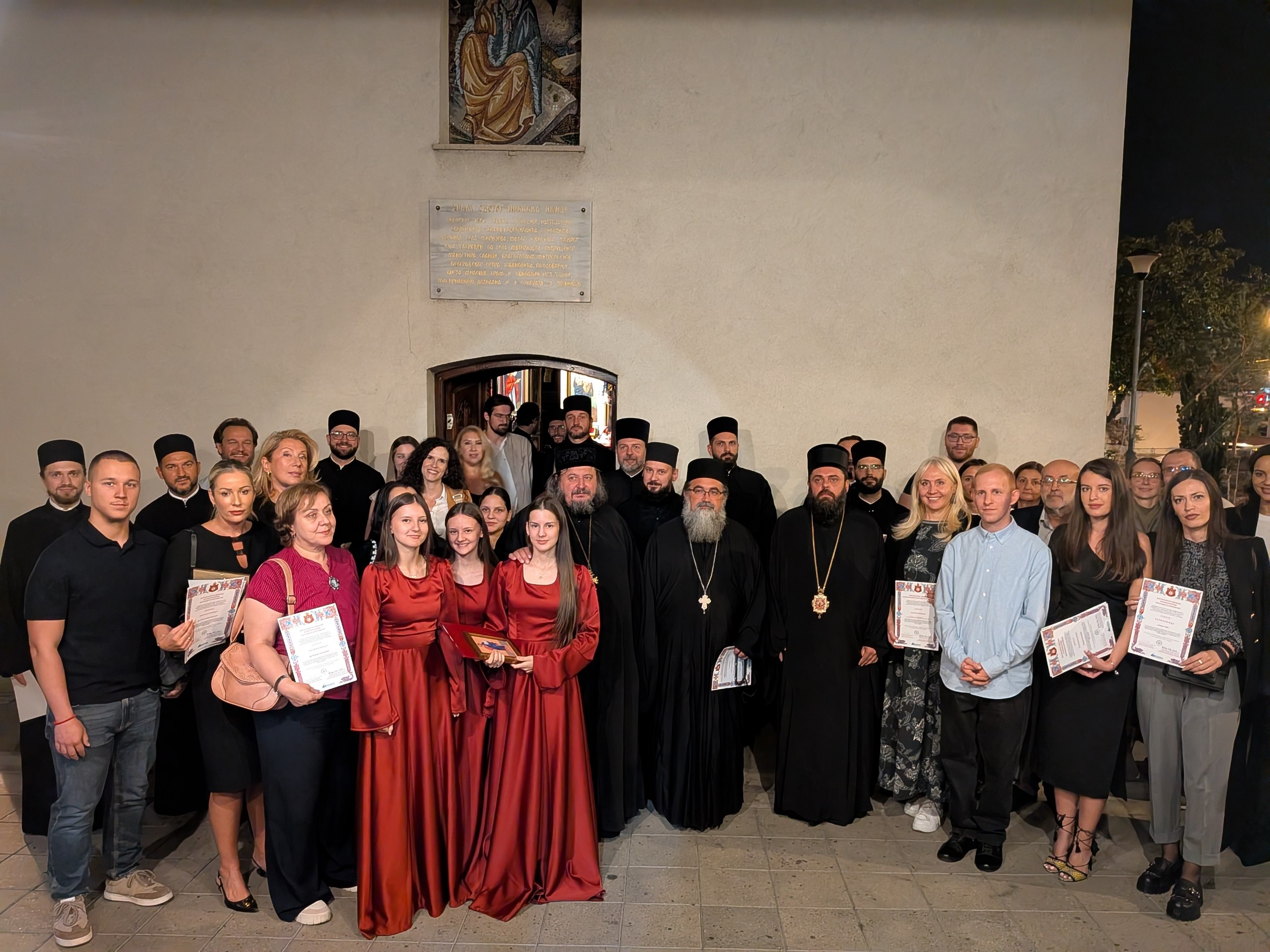
„Reports on the ‘Kinonia’ portal are not merely a collection of information, but a testament to the fact that the Church’s journey towards the eschaton—the Kingdom of God manifesting among us—continues in the same spirit of liturgical worship,“ said Protopresbyter Aleksandar Jevtić, a parish priest in Kraljevo and editor of the magazine *Žički Blagovesnik*, during a panel discussion held to mark „Kinonia’s“ second anniversary at the parish hall of the Church of the Holy Prophet Elijah in Mirijevo. Moderated by Sanja Anđelković Lubardić, an editor at Hram Television, the discussion also featured Protopresbyter Dr. Slobodan Jakovljević, a parish priest from Čačak, and Dr. Aleksandra Aničić, a psychiatrist from Valjevo. Attendees included His Grace Bishop Heruvim of Osječko Polje and Baranja, Archimandrite Gavrilo (Stevanović), Abbot of Ozren Monastery, Archimandrite Hrizostom, Abbot of Namasija Monastery, numerous clergy, „Kinonia“ portal associates; and the faithful.
„Ask not what your country can do for you—ask what you can do for your country“—quoting the globally renowned message of American President John F. Kennedy, Presbyter Dr. Oliver Subotić, Head of the Missionary Department of the Archbishopric of Belgrade-Karlovci, opened the panel discussion „Kinonia – A Call to Community“ by addressing a frequently asked question: „What could the Church do for me?“ Indeed, the words of the most popular statesman of the past century suggest that it is up to each of us to ask what we can do for the mission of „Mother Church.“ Born from this spirit of inquiry, initiative, and the enthusiasm of catechist Branislav Ilić from Novi Sad, the „Kinonia“ portal has emerged; for two years now, it has made a valuable contribution to the mission of the Serbian Orthodox Church. In Dr. Subotić’s view, Branislav Ilić’s example should inspire everyone to contribute to the Church’s mission in their own way or to assist others in this field. The „Kinonia“ portal stands as a symbol of togetherness and of gathering around the idea of learning about the Church’s mission, Presbyter Dr. Oliver Subotić noted, expressing hope that „Kinonia“ would continue to expand in the future through joint effort.
„Kinonia“ is already a recognizable name, one that—through its very meaning (fellowship, participation, partnership)—points to the joint action of multiple individuals. In ancient thought, this term possessed a social dimension, whereas, following the preaching of the Holy Apostle Paul (2 Cor. 13:14: „the love of God the Father and the communion of the Holy Spirit be with you all…“), it transitioned into a category of being. Namely, the Father, the Son, and the Holy Spirit constitute a perfect unity of love; God is not a solitary monad, but a communion. The Trinitarian communion serves as the model for every other community within the Church, noted Protopresbyter Dr. Slobodan Jakovljević, a parish priest in Čačak and a collaborator with „Kinonia.“ The Church is neither merely an institution nor a gathering of like-minded individuals; rather, it is a communion of the faithful with the Lord.
This communion is identified with the breaking of bread and prayers—with the Eucharist and Holy Communion. The Church exists not merely as an abstract idea, but quite concretely within the liturgical gathering of the community. The Apostle Paul articulates this thus: „There is one bread, and we are one body of Christ…“ Kinonia operates both vertically and horizontally: vertically, as a communion of faith in Christ; horizontally, as a communion of believers during Holy Communion. The first aspect of *koinonia*(in Greek) (communion/fellowship) in the Divine Liturgy is the gathering itself; Protopresbyter Slobodan Jakovljević illuminated the symbolism of this unity from the perspective of the Church and the liturgical community of the faithful—diverse individuals gathered around the bishop—wherein a shared prayer is offered. Indeed, the speaker emphasized, there is no such thing as a separate prayer of the priest and a prayer of the people—no individual prayer—but rather, exclusively, the prayer of the community. The commemoration of the living and the departed, both during the Proskomedia and the Divine Liturgy, transcends the boundaries of time and space, for the liturgical gathering unites those physically present with those being commemorated. Listening to the Word of God and professing the Creed demonstrates that one cannot simply hold a personal version of Christianity; rather, in articulating dogma, we show that we belong to one Church and believe in Christ. Furthermore, Protopresbyter Jakovljević added, *koinonia* is not merely a matter of belonging, but also concerns our relationships with one another—involving forgiveness and the effort to live as one; consequently, feelings of hatred or a refusal to forgive can serve as obstacles to receiving Holy Communion. The act of offering is a crucial element of this fellowship, a custom that dates back to ancient times.
One does not keep what is „mine“ for oneself; through the gathering, it becomes „ours.“ The bread and wine I brought become our Holy Communion. At the Liturgy, we offer not only gifts but also ourselves—our lives, time, sacrifice, and love. Thus, *koinonia* is not a community where we merely receive something, but one where we also offer something. The Eucharist, as the pinnacle of *koinonia*, is the centre of ecclesial communion—stated Protopresbyter Dr. Slobodan Jakovljević regarding the community formed in the liturgical gathering. This communion extends to how we treat family members, the needy, and everyone we encounter in daily life; for, as the speaker concluded, *koinonia* is not merely a sociological concept, socializing, friendship, or emotional warmth, but a participation in the Holy Communion that has sustained our people throughout the centuries.
The significance of the „Kinonia“ portal in the Church’s pastoral practice was the subject of a presentation by Protopresbyter Aleksandar Jevtić—a parish priest in Kraljevo, editor of the magazine *Žički Blagovesnik*, and a contributor to „Kinonia.“ Citing the words of the Holy Elder Porphyrios the Athonite—recently featured in an article on the „Kinonia“ portal—Father Aleksandar Jevtić began by explaining the Church as a house of prayer that is not bound by temporal categories or trends; rather, its fundamental criterion is encapsulated in the words of Saint Irenaeus of Lyons: „Our faith is in accord with the Eucharist, and the Eucharist confirms our faith.“ Church dogmas represent a revelation of eternal truths within history, and the task of theology is not merely to formulate them rationally but to translate them into lived experience, enabling the individual to participate in the communion of the Holy Trinity—spanning the ages past and those to come until the Second Coming of the Lord—noted Protopresbyter Aleksandar Jevtić. For this reason, he emphasized, the reports „Kinonia“ publishes regarding gatherings across our Church and other local Churches are of great importance.
These reports are not merely a collection of information, but a testimony that, through the same spirit of liturgical worship, the Church continues its journey towards the eschaton—the Kingdom of God manifesting in our midst. The teachings offered by clergy in the „From the Ambo“ column reflect Gospel truth—sometimes quoted verbatim, other times presented in a fresh guise. Following the same path are the lectures featured in the „From the Lectern“ column, a collection of talks delivered across our local Church. Thus, the „Kinonia“ portal offers a wealth of content with such broad reach that, even if we cannot travel to a specific location to attend in person, we still have the opportunity to hear these teachings. This represents the richness and advantage of digital media—an important tool in the Church’s hands—according to the editor of one of the Serbian Orthodox Church’s oldest publications (a periodical where Saint Bishop Nikolai left his mark during the interwar period). „Kinonia“ illuminates our path as we face the challenges of the modern age, such as artificial intelligence. Father Aleksandar Jevtić believes we may not fully realize the importance of having such a communal space in the online realm, especially given that people today often seek answers to various questions on the internet and risk „straying“ onto non-Orthodox websites containing harmful material.
We can direct someone to a specific website they can visit in the future to find topics—perhaps ones a priest had not identified—that can aid in their spiritual growth. At the same time, the priest himself has the opportunity to learn something new—Protopresbyter Aleksandar Jevtić praised the role of „Kinonia“ both in the spiritual life of the faithful and in the work of those who provide them with spiritual care. „Kinonia“ follows the Gospel call to reveal God’s truths as a New Testament vision of God—to which we bear witness to the best of our abilities—said Protopresbyter Aleksandar Jevtić, offering sincere praise to catechist Branislav Ilić for all he does as the editor of „Kinonia“ and as an author of its texts.
Dr. Aleksandra Aničić, a psychiatrist and associate of „Kinonia,“ shed light on the topic of the community’s influence on the individual. From the very moment of birth, an infant is dependent on the people surrounding them; this is where the communal relationships that are vital to each of us begin to develop. Subsequent milestones—such as starting kindergarten and school—are significant because they allow the child to interact with peers and teachers, encounter authority figures for the first time, and learn how to conduct themselves according to the rules of the social environment, Dr. Aničić noted.
The environment can be supportive, but it can also be a hindrance. For instance, we see peer violence today… Family and workplace relationships have a profound impact on us, and we cannot remain isolated from daily interactions. We must make a clear distinction between solitude and loneliness. Solitude is something a person sometimes chooses—a time to devote to oneself, one’s thoughts, or prayer… Serious scientific studies have demonstrated the importance of prayer regarding physical health, including blood pressure, heart rate, and so on. Loneliness is something entirely different—something we do not choose. It is a personal feeling of having no one to turn to when we need it, Dr. Aničić pointed out. Discussing the concept of „mature belonging,“ she explained that this refers to relationships in which we can express ourselves, our stances, and our opinions within a community, while also being open to constructive criticism from others—criticism that helps us improve.
We cannot remain the same tomorrow as we are today; we will either become worse or better. The significance of any relationship lies in its ability to help us progress in every sense. We often need to ask ourselves who is there for us—do we have someone we can call when things are tough? That is a crucial question. Human beings have both biological and social motives. Biological motives include the need for food, fluids, and the like, whereas social motives are those that develop through interaction with others. Psychiatry recognizes a human drive to find one’s place in society and contribute to the community, noted Dr. Aničić, citing altruism—the human need to make sacrifices for others—as an example.
Psychiatry views a person’s withdrawal into solitude as a psychological phenomenon; in such situations, telling the person to simply be grateful for what they have conveys a lack of understanding. Instead, we should offer support and assistance. In Dr. Aleksandra Aničić’s view, it is better to visit a doctor unnecessarily than to ignore the situation and risk the development of an illness. Speaking about social media as an integral part of modern life, she emphasized the need to approach social media content critically, analyze information sources, and reflect critically on what is read.
„The fact is, we have never been more lonely. We have so many daily contacts. Yet, what a person needs is not merely contact, but a genuine connection and conversation; we must always reach out and offer help when we see someone withdrawing or feeling lonely,“ concluded Dr. Aleksandra Aničić during the panel discussion „Kinonia – A Call to Community.“
At the conclusion of the gathering, the editor of *Kinonia*, catechist Branislav Ilić, expressed his gratitude to all the participants, collaborators, and readers of the portal. Sisters Marija, Irina, and Atanasija Savić enriched the event’s programme with their performance of spiritual songs. As was the case last year, certificates of appreciation were awarded to all those who, according to their gifts, contribute to the mission of the *Kinonia* portal.
Jadranka Janković