
Written by: Catechist Branislav Ilić, Editor of the “Kinonia” Portal
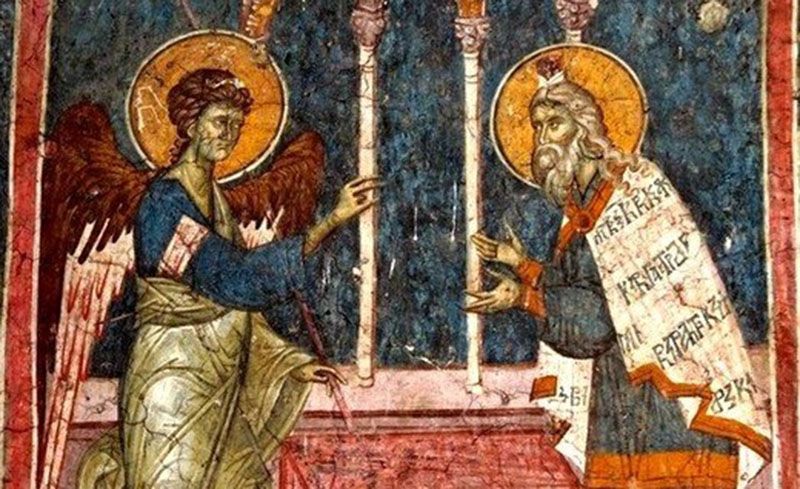
“Let us open the Holy Gospel written for us by the holy and glorious Luke, and we shall behold the honourable and radiant conception of the Forerunner, for it tells us that the righteous elder Zacharias entered into the Holy of Holies to offer incense during his priestly service, and that the Archangel Gabriel appeared to him and announced: you, a hierarch, shall be given a son in your old age— a prophet, and a Forerunner, a herald and preacher, an unquenchable light and the steward of divine grace.” These words from the ikos of the feast of the Conception of Saint John the Baptist introduce us to the mystery of this sacred event, in which the power of faith is revealed.
“Zacharias was serving in the temple of God, offering sacrifices to the All-merciful Benefactor on behalf of the people, and he beheld an angel of God, who said to him: your prayer and supplication have been heard; do not fear, old man, and do not be unbelieving, for you shall be given a child—the Forerunner of God, the greatest among those born of women—who shall come in the power of Elijah and go before Christ.” Thus, in the first sticheron at Lord, I have cried of the feast of the Conception of Saint John, the wondrous encounter and dialogue between the Archangel Gabriel and the high priest Zacharias are described.
Zacharias and Elizabeth, as the Evangelist Luke tells us, were righteous before God. And who is righteous? Those who walk uprightly before the Lord. The straight path is the way by which the Lord leads us, showing us what we should do and what we should refrain from doing. The Lord instructs our hearts daily, for the righteous person not only knows how to read and fulfill the commandments, but also how to hear what the Lord speaks within the heart. Such were the righteous Zacharias and Elizabeth. Thus, on the eve of this day, Zacharias entered the temple, the Holy of Holies, to offer a sacrifice on behalf of all the people—to place incense upon the altar. As he approached the altar, he saw an angel standing on his right side and was afraid. We recall how the Theotokos responded when the Archangel Gabriel appeared to her: she pondered in her heart and remained silent. But Zacharias was afraid. And the angel said to him: “Fear not, for your prayer has been heard. You and Elizabeth shall bear a son. You shall name him John, and he will bring many to the Lord God.” We see here that God acts—He comforts Zacharias and, through him, the entire people. Zacharias’s prayer is heard for the sake of all, yet the Lord grants him a child who will lead the people to repentance and prepare them to receive the Word of God. John will proclaim: “Repent, for the kingdom of heaven is at hand.” To repent means to look into one’s heart; to repent means to become righteous before God. Pray and fulfill your duty, as the priest Zacharias did. For every person has a duty before God: one serves as a priest, another sings in the temple, another assists in service; all—children, parents, and teachers alike—have a sacred duty before the Lord. And if we walk uprightly through life, we will place our divine duty above all else.
The Evangelist Luke tells us that Zacharias was a priest of the Old Covenant in the Temple of Jerusalem. The priesthood of the Old Testament temple was different: the chief concern of the priests was the offering of sacrifices. It is known that Zacharias and his wife Elizabeth were both advanced in years, childless, and throughout their lives had prayed fervently that the Lord might grant them a child. From the history of Israel we know that parents without children were often despised by the people of Israel, for it was believed that if the Lord did not grant them offspring, they must have committed some grave sin and were rejected or cursed by God. Of course, this was a mistaken judgment formed among the people. And so Zacharias and Elizabeth continued to pray earnestly, even though they had seemingly lost all hope.
From the Gospel account that we read on the feast of the Conception of Saint John the Prophet, Forerunner, and Baptist of the Lord, we receive precious lessons. This feast teaches us never to lose faith in God and always to maintain hope, knowing that the Lord loves us. The righteous Zacharias and Elizabeth lived in a time preceding the Incarnation of our Lord Jesus Christ, while we live in a time when the Lord has already come into the world, has already redeemed each of us, and has bestowed upon us His love and mercy. Therefore, we have all the more reason never to lose faith, hope, or trust in God—to keep ever in our hearts the truth that He is near to us, and that all He does in our lives is for our salvation. The ultimate reason for His coming into the world, His ascent upon the Cross, is to bring each of us into the eternal and imperishable Kingdom of God.
It is precious always to recall the Gospel examples: Zacharias and Elizabeth, the parents of Saint John; Joachim and Anna, the parents of the Most Holy Theotokos; and other biblical examples that reach us from the depths of time, showing that the Lord knows best the path of our salvation. Our Christian task may seem simple: to believe in God, to believe and to live according to the Gospel; and when temptation arises, when distrust appears, and when our faith falters and doubts emerge, we should direct our prayers as did the Prophet Zacharias, his wife Elizabeth, the holy ancestors of God Joachim and Anna, and the Most Holy Theotokos, who witnessed the suffering of her Son upon the Cross.
We are called to lift our prayers to the Prophet Zacharias and the Righteous Elizabeth and to ask their intercession, that they may help us accept what unfolds in our lives, and teach us to trust in God—so that through steadfast faith we may preserve hope and multiply love.
It is fitting to crown this reflection on the feast of the Conception of Saint John the Prophet, Forerunner, and Baptist of the Lord with the words from one of the evening stichera of the feast: “Forerunner, thou didst come forth as an angel from a barren womb, and from the very swaddling clothes thou didst dwell in the wilderness. Thou wast shown to be the seal of the prophets, for Him whom they foretold and proclaimed in figures thou wast found worthy to baptize in the Jordan; and thou didst hear the Father’s voice from heaven bearing witness to His Sonship, and didst behold the Spirit descending as a dove upon Him that was baptized. Therefore, O greatest of the prophets, cease not to pray for us who with faith celebrate thy memory.”